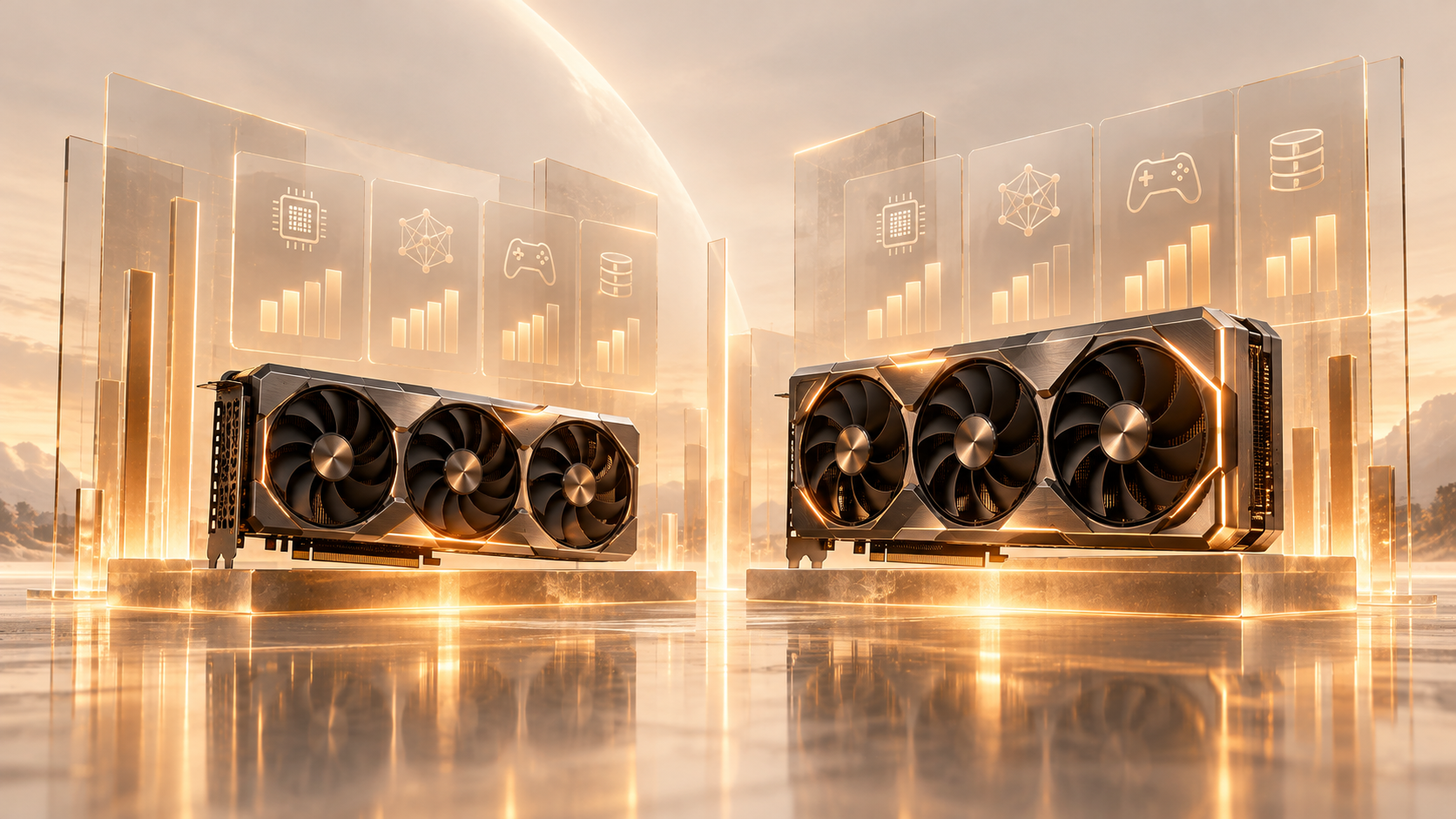
The RTX 4090 vs RTX 5090 comparison is important for AI developers, gamers, researchers, and businesses looking for powerful GPU computing.
NVIDIA's RTX 5090 introduces Blackwell architecture, 32GB GDDR7 memory, and significantly higher memory bandwidth. However, the RTX 4090 remains capable of handling demanding AI inference, deep learning, rendering, and 4K gaming workloads.
So, is the RTX 5090 worth upgrading to?
This RTX 4090 vs RTX 5090 guide covers specifications, independent benchmarks, AI performance, power consumption, and GPU rental prices in India. We'll also explore how Race Engineering makes high-performance GPU computing accessible without expensive hardware purchases.
RTX 4090 vs RTX 5090: Quick Comparison
The biggest difference between these GPUs is memory capacity, bandwidth, and architecture.
| Specification | RTX 4090 | RTX 5090 |
| Architecture | Ada Lovelace | Blackwell |
| Cuda Cores | 16,384 | 21,760 |
| VRAM | 24 GB GDDR6X | 32GB GDDR7 |
| Memory Bandwidht | 1,008 GB/s | 1,792 GB/s |
| Memory interface | 384 bit | 512 bit |
| Tensor cores | 4th genration | 5th genration |
| Ray tracing cores | 3rd genration | 4th genration |
| Graphics Power | 450W | 575W |
| Launch MSRP | $1,599 | $1,999 |
| Best Suited For | Value focused AI and 4k Gaming | Larger Ai Workloads and maximum performance |
Source: NVIDIA's official GPU specifications. Prices represent US launch MSRP.
The RTX 4090 vs RTX 5090 specifications show that the newer GPU delivers approximately 33% more CUDA cores, 33% additional VRAM, and 78% greater theoretical memory bandwidth.
However, these hardware improvements do not translate directly into identical percentage gains across every application.
RTX 4090 vs RTX 5090: Architecture Differences
Architecture influences how efficiently a GPU processes graphics and AI workloads.
RTX 4090: Ada Lovelace
The RTX 4090 uses NVIDIA's Ada Lovelace architecture with fourth-generation Tensor Cores.
Its 24GB VRAM makes it suitable for machine learning experiments, image generation, 3D rendering, and quantized language models.
For developers working with workloads that fit comfortably within memory, it remains a practical choice.
RTX 5090: Blackwell
The RTX 5090 introduces fifth-generation Tensor Cores, improved ray tracing hardware, and GDDR7 memory.
Blackwell supports newer AI precision capabilities that can benefit compatible machine learning frameworks.
The RTX 4090 vs RTX 5090 architecture decision ultimately depends on whether your applications can use these improvements effectively.
RTX 4090 vs RTX 5090: AI and Machine Learning Performance
For developers, RTX 4090 vs RTX 5090 is primarily a comparison of memory capacity, inference speed, and workload efficiency.
Both GPUs support CUDA, PyTorch, and commonly used AI development frameworks.
LLM Inference Performance
Large language model inference depends on available VRAM, memory bandwidth, quantization, and context length.
The RTX 4090 handles many quantized 7B, 8B, and 14B models comfortably, depending on configuration.
The RTX 5090 provides additional memory for larger models, longer contexts, and increased batching.
Independent llama.cpp benchmark results illustrate the difference.
| LLM inference benchmark | RTX 4090 | RTX 5090 |
| Llama2 7BQ4_0, genration flash attention off | 186.21 tokens/s | 290.02 tokens/s |
| Llama 2 7BQ4_0, genration,flash attention on | 188.96 tokens/s | 300.40 tokens/s |
Source: Community-submitted llama.cpp benchmark results summarized by SpecPicks. These are specific benchmark configurations, not guaranteed production throughput.
In this RTX 4090 vs RTX 5090 inference test, the newer GPU demonstrates higher token generation throughput.
However, results depend on model architecture, framework versions, drivers, and workload settings.
Training and Fine-Tuning
The RTX 4090 remains useful for computer vision, smaller neural networks, and parameter-efficient fine-tuning.
The RTX 5090 offers additional memory and newer Tensor Core capabilities.
For large-scale training, neither GPU replaces dedicated data-center accelerators in every scenario.
Explore Race Engineering's H100 GPU, H200 GPU, and A100 GPU infrastructure for workloads requiring greater memory capacity.
You can also read our Best GPU for Fine-Tuning LLMs in 2026 guide.
RTX 4090 vs RTX 5090: VRAM and Memory Bandwidth
Memory is one of the most important differences in the RTX 4090 vs RTX 5090 comparison.
The RTX 4090 provides 24GB GDDR6X memory, while the RTX 5090 offers 32GB GDDR7.
That additional 8GB can accommodate larger model weights, increased batch sizes, or longer inference contexts.
Memory bandwidth increases from 1,008 GB/s to 1,792 GB/s.
For memory-bound inference, higher bandwidth can improve performance significantly.
However, the RTX 4090 vs RTX 5090 memory advantage matters most when applications are limited by memory capacity or throughput.
A workload requiring more than 32GB may still need model quantization, CPU offloading, or a larger GPU.
RTX 4090 vs RTX 5090: Gaming Benchmarks
The RTX 4090 vs RTX 5090 gaming comparison favors the newer GPU, particularly at 4K resolution.
Independent GamersNexus testing reported approximately 20–50% higher performance for the RTX 5090 in selected 4K rasterization benchmarks.
Its 4K ray tracing results showed gains of approximately 27–35%, depending on the game.
These are measured ranges across tested titles, not universal performance improvements.
The RTX 5090 also supports DLSS Multi Frame Generation, producing additional displayed frames in compatible games.
However, generated frames should not be confused with native rendering performance.
For RTX 4090 vs RTX 5090 gaming decisions, the RTX 4090 remains capable at 4K, while the RTX 5090 offers additional headroom for demanding settings.
Benchmark source: GamersNexus, January 24, 2025.
RTX 4090 vs RTX 5090: Power Consumption
The RTX 4090 vs RTX 5090 power comparison highlights an important operating-cost consideration.
The RTX 4090 has a 450W total graphics power rating, compared with 575W for the RTX 5090.
The RTX 5090 therefore has approximately 28% higher rated graphics power.
NVIDIA recommends an 850W system power supply for the RTX 4090 and 1,000W for the RTX 5090 Founders Edition.
Actual energy usage depends on workload utilization.
For businesses operating GPU infrastructure regularly, electricity, cooling, maintenance, and hardware depreciation all affect total ownership cost.
RTX 4090 vs RTX 5090: GPU Rental Price in India
The RTX 4090 vs RTX 5090 pricing decision extends beyond purchasing hardware.
Race Engineering provides cloud GPU infrastructure that allows developers to rent computing resources without owning physical servers.
Published rates currently include:
| GPU | Hourly Price | 10 Hours | 50 Hours | 100 Hours |
| RTX 4090 | ₹50 | ₹500 | ₹2,500 | ₹5000 |
| RTX 5090 | ₹92 | ₹920 | ₹4,600 | ₹9,200 |
Illustrative compute-only costs based on published Race Engineering rates, excluding applicable GST and any additional charges. Verify availability and pricing before deployment.
For RTX 4090 vs RTX 5090 rental comparisons, the RTX 5090 costs 84% more per hour at these listed rates.
Consequently, it must finish an identical workload in approximately 54% of the RTX 4090's runtime to match its compute cost.
A faster GPU is not automatically cheaper per completed task.
Explore Race Engineering's GPU pricing or read our GPU Rental Cost in India guide for further cost planning.
Why Choose Race Engineering for GPU Rental?
Race Engineering provides Indian businesses, developers, and researchers with GPU cloud infrastructure billed in INR.
Instead of purchasing expensive hardware, teams can rent GPUs and GPU servers according to project requirements.
The platform offers:
. Flexible computing: GPU instances for AI training, inference, and development.
. INR billing: Transparent pricing with GST invoices.
. Developer environments: Access to CUDA, PyTorch, JAX, and other development tools.
. Scalable infrastructure: Options ranging from RTX-class GPUs to data-center accelerators.
. Enterprise assistance: Support for specialized infrastructure requirements.
Developers searching for GPU cloud pricing India and hourly GPU rental can compare instance options before deployment.
For dedicated capacity, Contact Race Engineering to discuss enterprise GPU cloud support India, bulk GPU cluster booking, or customized infrastructure requirements.
RTX 4090 vs RTX 5090: Which Should You Choose?
Choose the RTX 4090 when your workloads fit within 24GB VRAM, budget matters, and current performance meets your needs.
Choose the RTX 5090 when you need 32GB memory, higher bandwidth, or improved performance for supported AI and graphics workloads.
The RTX 4090 vs RTX 5090 decision should prioritize actual execution time, memory requirements, and total cost rather than specifications alone.
For occasional or project-based computing, GPU rental may provide better flexibility than buying hardware.
Final Verdict: RTX 4090 vs RTX 5090
The RTX 4090 vs RTX 5090 comparison shows meaningful improvements in architecture, VRAM, memory bandwidth, and performance.
The RTX 5090 is generally the stronger GPU, but the RTX 4090 remains an economical option for many AI workloads.
Evaluate model requirements, execution time, and compute costs before choosing.
With Race Engineering's GPU cloud, developers can access computing infrastructure without making large upfront hardware investments.
Frequently Asked Questions
Q1. Is RTX 5090 faster than RTX 4090?
Yes. The RTX 5090 generally delivers higher performance, although improvements vary across gaming, AI inference, and rendering applications.
Q2. Is RTX 4090 still good for AI in 2026?
Yes. Its 24GB memory capacity remains useful for quantized LLM inference, computer vision, and supported fine-tuning tasks.
Q3. Is RTX 5090 worth the extra rental cost?
It depends on workload speed and memory requirements. If faster completion offsets its higher hourly rate, the RTX 5090 may deliver better value.
Q4. Can I rent RTX 4090 or RTX 5090 GPUs in India?
Race Engineering publishes RTX 4090 and RTX 5090 cloud pricing, although availability varies by location and instance type.